



Indian sandalwood visibly improve skin tone and texture and reduce the appearance of wrinkles and fine lines,
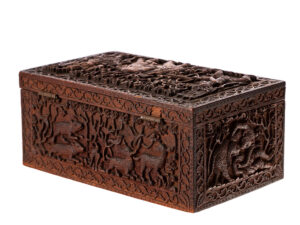 19th Century Indian Carved Sandalwood Box Elephants MysoreThe sandal tree, botanically known as Santalum album belongs to the family Santalaceae. The sandal tree grows almost exclusively in the forests of Karnataka, followed by Tamil Nadu, Kerala and Andhra Pradesh. As the tree grows, the essential oil develops in the roots and heartwood, which requires at least 15 to 20 years, however full maturity is reached after 60 to 80 years. The core of dark heartwood gradually develops, which is covered by outer sapwood. The sandalwood tree is never felled, but uprooted in the rainy season, when the roots are richer in the precious essential oil. The best quality oil comes from the Indian provinces of Mysore and Tamil Nadu, where the harvest of sandalwood trees are protected by the state government.
The tree is medium sized 12-15 meters tall. The tree reaches its full maturity in 60 to 80 years, which is when the center of the slender trunk (the heart wood) has achieved its greatest oil content. Both the heartwood and roots are fragrant and contain the oil; the bark and sapwood however are odorless. The Sandalwood tree is never cut down, but uprooted during rainy season, when it is richer in precious essential oils. The sandal tree does very well on its own, and seems to appear in places it was never seen before.
Many people feel that essential oil produced from any sandalwood tree (even Mysore) do not have the same psychotropic, emotional, spiritual, or medicinal benefits that we find in the wood powder or incense burning that is centuries old. Ayurvedic healers either used powdered sandalwood or the burning of sandalwood pieces in their ancient practice. Essential oils and attars may have also been used in Indian medicine, but were made popular in the west by the perfume industry by 1920s French aromatherapists, leading to sandalwood being applied medicinally in the western world.
Other Species
Pterocarpus santalius or Santalum rubrum (red sandalwood) are primarily used for coloring and dyeing. Other varieties come from the Sandwich Islands, Western Australia and New Caledonia. The Australian S. spicatum or Eucarya spicata produce a very similar oil, but with a dry-bitter top note. Other varieties growing in the West Indies, Venezuelan, Jamaica, and Haiti are Amyris balsamifera L., which is not of the same family.
History / Traditions
Sandalwood has a sacred 4,000 year old history of being mentioned in Sanskrit and Chinese manuscripts. The oil was used in religious rituals, and many deities, temples & sacred carvings were crafted from its soft wood. The ancient Egyptians imported the wood and used it in medicine, embalming and ritual burning to venerate their gods. In Buddhism, it is considered to be one of the three incenses integral to Buddhist practice, together with aloeswood and cloves. Depression, anxiety and insomnia were thought to be improved by sandalwood and was believed to promote spiritual practices, peaceful relaxation, openness and “grounding.” It is used in many death ceremonies to help the crossing over, and to comfort mourners as well as in many forms of initiation rites to open the disciples’ mind to receive consecration. In the Zoroastrian Temples, it burns in sacred fires to soothe the troubles of all humanity. It is used by the Jewish, the Buddhist, the Hindus, as well as almost every other belief system for its vast diversity in attributes.
19th Century Indian Carved Sandalwood Box Elephants MysoreThe sandal tree, botanically known as Santalum album belongs to the family Santalaceae. The sandal tree grows almost exclusively in the forests of Karnataka, followed by Tamil Nadu, Kerala and Andhra Pradesh. As the tree grows, the essential oil develops in the roots and heartwood, which requires at least 15 to 20 years, however full maturity is reached after 60 to 80 years. The core of dark heartwood gradually develops, which is covered by outer sapwood. The sandalwood tree is never felled, but uprooted in the rainy season, when the roots are richer in the precious essential oil. The best quality oil comes from the Indian provinces of Mysore and Tamil Nadu, where the harvest of sandalwood trees are protected by the state government.
The tree is medium sized 12-15 meters tall. The tree reaches its full maturity in 60 to 80 years, which is when the center of the slender trunk (the heart wood) has achieved its greatest oil content. Both the heartwood and roots are fragrant and contain the oil; the bark and sapwood however are odorless. The Sandalwood tree is never cut down, but uprooted during rainy season, when it is richer in precious essential oils. The sandal tree does very well on its own, and seems to appear in places it was never seen before.
Many people feel that essential oil produced from any sandalwood tree (even Mysore) do not have the same psychotropic, emotional, spiritual, or medicinal benefits that we find in the wood powder or incense burning that is centuries old. Ayurvedic healers either used powdered sandalwood or the burning of sandalwood pieces in their ancient practice. Essential oils and attars may have also been used in Indian medicine, but were made popular in the west by the perfume industry by 1920s French aromatherapists, leading to sandalwood being applied medicinally in the western world.
Other Species
Pterocarpus santalius or Santalum rubrum (red sandalwood) are primarily used for coloring and dyeing. Other varieties come from the Sandwich Islands, Western Australia and New Caledonia. The Australian S. spicatum or Eucarya spicata produce a very similar oil, but with a dry-bitter top note. Other varieties growing in the West Indies, Venezuelan, Jamaica, and Haiti are Amyris balsamifera L., which is not of the same family.
History / Traditions
Sandalwood has a sacred 4,000 year old history of being mentioned in Sanskrit and Chinese manuscripts. The oil was used in religious rituals, and many deities, temples & sacred carvings were crafted from its soft wood. The ancient Egyptians imported the wood and used it in medicine, embalming and ritual burning to venerate their gods. In Buddhism, it is considered to be one of the three incenses integral to Buddhist practice, together with aloeswood and cloves. Depression, anxiety and insomnia were thought to be improved by sandalwood and was believed to promote spiritual practices, peaceful relaxation, openness and “grounding.” It is used in many death ceremonies to help the crossing over, and to comfort mourners as well as in many forms of initiation rites to open the disciples’ mind to receive consecration. In the Zoroastrian Temples, it burns in sacred fires to soothe the troubles of all humanity. It is used by the Jewish, the Buddhist, the Hindus, as well as almost every other belief system for its vast diversity in attributes.

Indian Sandalwood Tops Vitamin E for Antioxidant Activity
admin bpp