

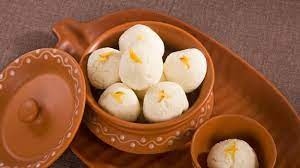
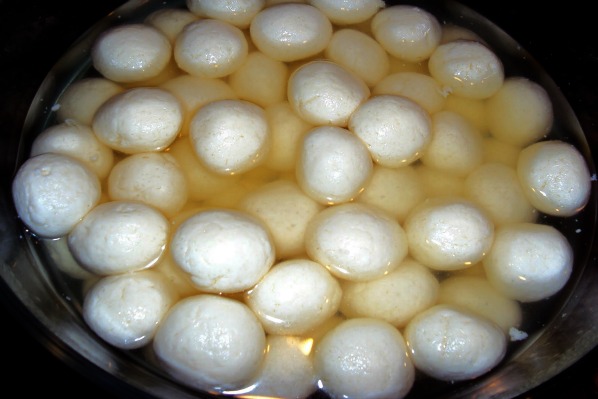
The famous British chef William Harold described it in a journal – “a bowl of sweet, syrupy, soft cheese balls.”
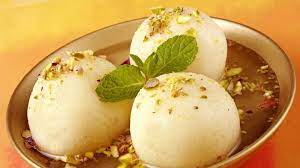 There are some interesting facts about the origins of this celebrated Indian sweet. Odias claim that the answer lies in the history of Puri in Odisha, where this 700-year-old sweet dish was part of a ritual. The legend goes that Lord Jagannath offered the sweets to his consort Lakshmi, to pacify her for not being taken along during the Rath Yatra or ritual chariot ride.
Known as khira mohana due to its almost white appearance back in the 11th century, it thus became customary to offer this chenna sweet dish to Goddess Mahalakshmi as prasad, especially on the last day of the Rath Yatra, also called Niladri Vijay.
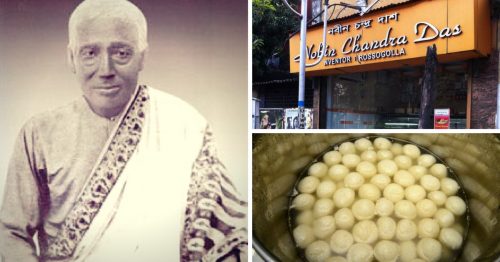
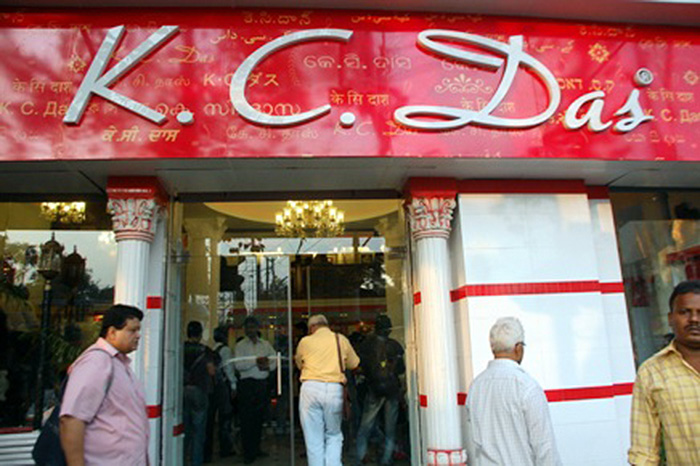
Das’s invention became a huge success among Bengalis. Legend has it that Pashupati Bhattacharya, a famous medical practitioner of Bagbazar, used to carry Das’s rasgulla whenever he visited Rabindranath Tagore. Once, the shop had run out of stock when Bhattacharya arrived. As a result, he had to purchase the sweet from a nearby shop. Tagore felt the difference at once and asked the doctor to bring rasgulla from Das’s shop only.
 An interesting anecdote about the deep fondness British colonial rulers in India harboured for the rasgulla.William Harold was a famous British cook who was sent to India to help with the war efforts. His dishes were so delicious that a high ranking officer, who tried one of dishes, ultimately promoted him to be his personal cook. One day, the officer ordered William to fetch the recipe of the rasgulla, a local dish he ate and fell in love with.
Back then, written recipes were very few and very between, so William had to physically walk from home to home, knocking on every door, in order to get hold of that recipe. Howevre, in spite of his on-field research, he failed to acquire the recipe of the rasgulla.
An interesting anecdote about the deep fondness British colonial rulers in India harboured for the rasgulla.William Harold was a famous British cook who was sent to India to help with the war efforts. His dishes were so delicious that a high ranking officer, who tried one of dishes, ultimately promoted him to be his personal cook. One day, the officer ordered William to fetch the recipe of the rasgulla, a local dish he ate and fell in love with.
Back then, written recipes were very few and very between, so William had to physically walk from home to home, knocking on every door, in order to get hold of that recipe. Howevre, in spite of his on-field research, he failed to acquire the recipe of the rasgulla.
Every home he visited gave him a different recipe and a different technique to work with. Unable to replicate the result, Harold left the country with 10 boxes of rasgulla and the hope that he would eventually be able to recreate the dish. Whether he ever succeeded in doing so remains a mystery.
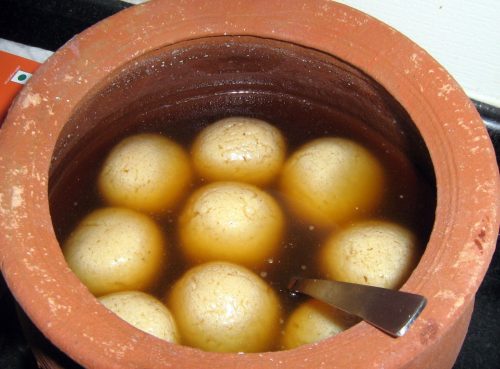
Odisha is also citing Pundit Suryanarayan Dash’s Sahitya Akademi award-winning ‘Odia Sahitya ra Itihasa‘, which mentions ‘Dandi Ramayan‘ and its pointers to Odia food including rasgulla. Some Odia enthusiasts have even called for observation of Rasgulla Diwas, coinciding with the Rath Yatra of the three revered deities of Puri’s Jagannath Temple.
admin bpp